Every UK construction site runs on a set of rules. They vary in wording from site to site, but the substance barely changes — because most of them are not the principal contractor's preferences. They are the practical face of legal duties under the Construction (Design and Management) Regulations 2015 and related legislation.
This page lists the twelve rules you will meet on almost any UK site, and — unlike the version pinned to the welfare unit wall — the regulation or HSE guidance that sits behind each one. Knowing why a rule exists makes it considerably easier to brief, enforce and follow.
Under CDM 2015, the principal contractor must set out site rules and health and safety arrangements in the construction phase plan — site rules are a legal obligation, not a discretionary extra. HSE guidance is also clear that rules must be written and communicated so that every person expected to follow them genuinely understands them, including workers whose first language is not English.
The 12 rules
1. Complete the site induction before starting work
No one starts work without a site-specific induction. This is a duty on the principal contractor under regulation 13 of CDM 2015, and the induction has a defined minimum scope: it must cover the project-specific risks — including the high-risk activities listed in Schedule 3 of the regulations — the site management structure, first aid arrangements, accident reporting and emergency procedures.
2. Sign in and sign out, every time
The principal contractor is legally required to take reasonable steps to stop unauthorised people entering the site. The signing-in register is the everyday mechanism: it proves who is on site, supports the fire roll call, and is why visitors are inducted, supervised or accompanied in hazardous areas.
3. Wear the PPE the site specifies
Minimum PPE (typically hard hat, hi-vis, safety boots) is set in the site rules, and task-specific PPE comes from your own risk assessment. Remember that PPE sits at the bottom of the hierarchy of control — it is the backstop after other controls, not a substitute for them, which is why "wear PPE" alone is never an acceptable control measure in a RAMS document.
4. Keep to pedestrian routes — stay out of plant zones
Regulations 27 and 28 of CDM 2015 (Part 4) require sites to be organised so vehicles and pedestrians move on separated, clearly defined routes. HSE treats segregation as a site-wide legal obligation, not a recommendation for large projects — it applies just as much to a house extension with one dumper.
5. No work at height without the right equipment
Work at height is the single largest cause of fatal and serious injury in UK construction, and falls from ladders and through fragile surfaces are the most common scenarios. The Work at Height Regulations 2005 set the hierarchy: avoid work at height where possible, prevent falls with the right equipment where not, and minimise the consequences where falls cannot be prevented. Collective protection (scaffolds, towers, MEWPs) comes before personal protection (harnesses).
6. Keep your work area tidy
Same-level slips and trips rank among the dominant causes of acute injury on site, alongside manual handling. CDM 2015 Part 4 requires sites to be kept in good order. In practice: clear your waste as you go, keep routes and ladder access clear, and coil leads and hoses out of walkways.
7. Never enter an unsupported excavation
Regulations 22 and 23 of CDM 2015 impose dedicated duties for excavations: they must be supported or battered to prevent collapse, and regulation 24 requires formal, documented inspections before each shift and after any event that could affect stability. A metre of collapsing soil weighs more than a tonne — there is no "just nipping in". If the work involves breaking ground, a permit to dig usually applies too.
8. Only operate plant you are trained and authorised for
Plant operation is restricted to trained, competent and authorised operators, and idle plant must be immobilised with keys removed. The same competence principle runs through your RAMS: reviewers expect the document to state the training and tickets required for the operatives doing the work.
9. No hot works without a permit
Welding, grinding, torch-applied roofing and similar spark- or flame-producing work needs a hot work permit on almost every managed site, with controls that continue after the work stops — typically a fire watch for at least an hour. The legal framework is the Regulatory Reform (Fire Safety) Order 2005, with HSG168 as the HSE guidance for construction fire safety.
10. Report near misses and unsafe conditions
A near miss is free information about the next accident. Site procedures require near misses and unsafe conditions to be reported, and anything posing a serious risk corrected immediately rather than logged for later. Specified injuries and dangerous occurrences carry statutory reporting duties under RIDDOR — see near miss reporting for what must be reported and by whom.
11. Know the emergency arrangements
First aiders, the assembly point, and the accident reporting procedure are covered in your induction because regulation 13 requires them to be. The test is simple: if the alarm sounded now, would you know where to go and who the first aider is? Your own RAMS must carry site-specific emergency arrangements too — generic "call 999" entries are one of the common reasons RAMS get rejected.
12. Secure the site at the end of the day
Sites attract children once the workforce leaves. HSE's public-protection guidance sets out the end-of-day routine: secure the perimeter, cover or barrier excavations and pits, immobilise and ideally compound plant, remove ladders from scaffolds and excavations, and stack materials so they cannot topple. The site's last task each day is making it safe for the people who should not be there.
Free infographic — use it for inductions and toolbox talks
A one-page version of these rules, free to download, print and embed:
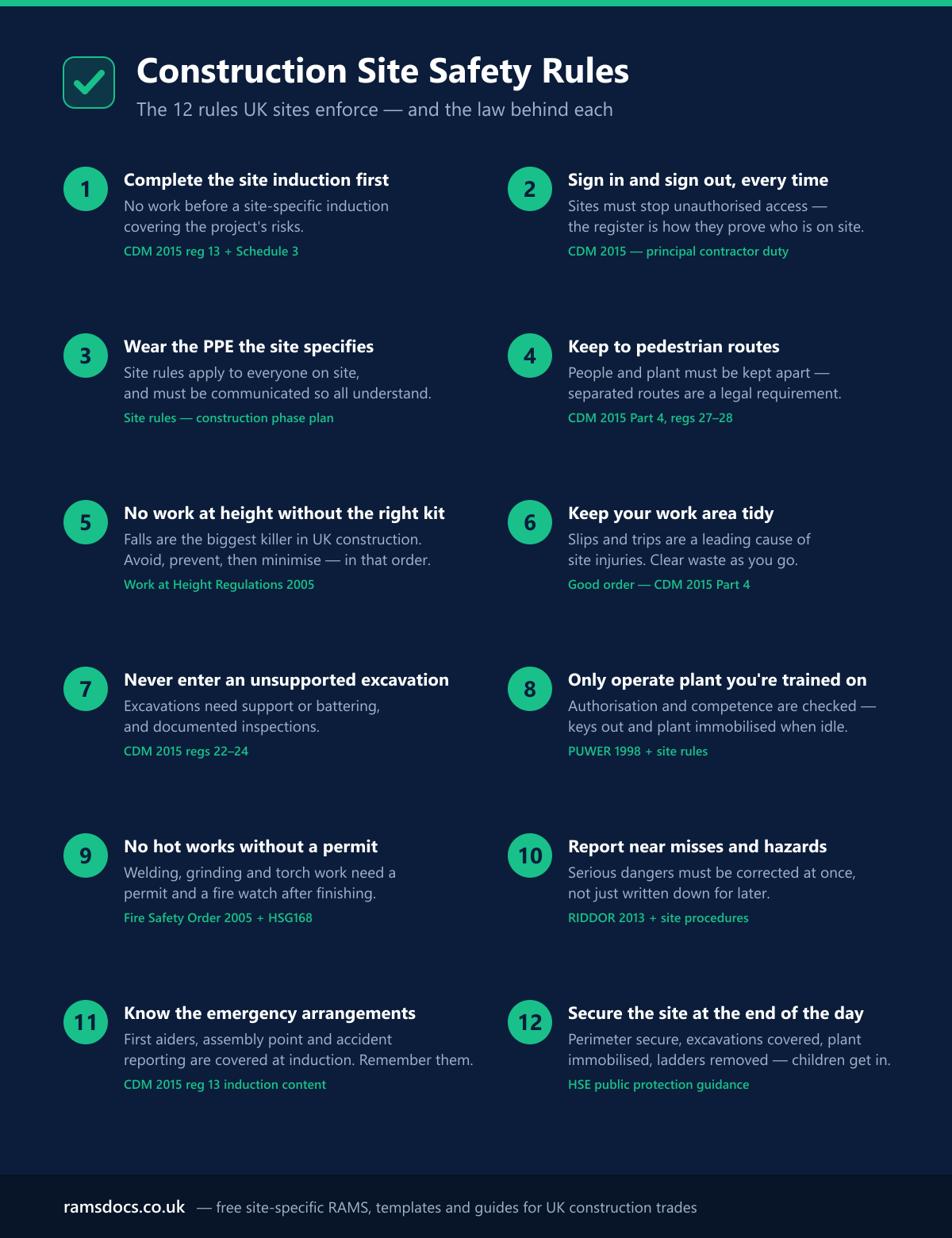
You are welcome to use this infographic on your own website, in inductions or in training material, with attribution. Copy this embed code:
<a href="https://ramsdocs.co.uk/guides/construction-site-safety-rules/">
  <img src="https://ramsdocs.co.uk/images/construction-site-safety-rules-infographic.png"
       alt="Construction site safety rules — the 12 rules UK sites enforce (ramsdocs.co.uk)"
       width="600" loading="lazy" />
</a>
<p>Source: <a href="https://ramsdocs.co.uk/guides/construction-site-safety-rules/">RamsDocs — Construction site safety rules</a></p>
Site rules and your RAMS
Site rules and RAMS meet in the review process: the principal contractor checks that your method of work aligns with the construction phase plan, the site rules, traffic management and any permit systems before you are allowed to start. A RAMS that conflicts with the site rules — or ignores them — is a RAMS that comes back rejected. If you need a starting point, every RamsDocs template carries the competence, PPE, permit and emergency sections reviewers look for.
Frequently Asked Questions
Are site safety rules a legal requirement? The rules themselves are set by the principal contractor, but setting them is a legal duty: under CDM 2015 the construction phase plan must document the site rules and health and safety arrangements for the project. Several of the most common rules also restate specific regulations directly — traffic segregation, excavation support and work-at-height controls are legal requirements in their own right.
Who enforces safety rules on a construction site? Day to day, the principal contractor's site management enforce the rules, backed by the contractual right to remove people from site. The Health and Safety Executive (HSE) enforces the underlying law and can issue improvement and prohibition notices or prosecute for breaches.
Do site safety rules apply to visitors and delivery drivers? Yes. The principal contractor's duty to prevent unauthorised access and to control risk applies to everyone who sets foot on site. Visitors are typically inducted in a shortened form, escorted, or restricted to safe routes and zones — and delivery drivers are a recognised high-risk group for traffic-management rules.
Can I be removed from site for breaking the rules? Yes. Removal for safety breaches is standard practice and is usually written into subcontract terms. Repeat or serious breaches (entering exclusion zones, working at height without protection, defeating plant interlocks) are commonly treated as immediate-removal offences.
What is the difference between site rules and RAMS? Site rules are set by the principal contractor and apply to everyone on the project; RAMS are produced by each contractor for their own work activities. The two must align — reviewers check your RAMS against the site rules and construction phase plan, and a conflict between them is a standard rejection reason.
Sources Used
This guide is checked against official source material. Verify current legal duties against the live legislation and HSE guidance before relying on the content for a live project.
- Management of Health and Safety at Work Regulations 1999, regulation 3 (legislation.gov.uk)
- Construction (Design and Management) Regulations 2015 (legislation.gov.uk)
- Managing risks and risk assessment at work (HSE)
- Planning for construction work (HSE)
Put This Guide To Work
Use the related templates, trade hubs and free tools below to turn the guidance into a site-specific RAMS workflow.